
A Guide to Choosing the Best Interpretation, Translation, & AI Language Partner

23 min read

In This Blog Post

Why Choosing the Right Language Service Provider Matters

Choosing a new language services provider can feel like a gamble. Every change means retraining staff, adjusting systems, and relying on a partner you may not fully know yet. If that choice doesn’t pay off, you’ve wasted time and money and exposed your organization to compliance risks under ADA and Title VI. 

And it’s not just your team that’s depending on you to make the right call. The provider you choose can impact whether patients can understand and follow their care plans, whether families can participate fully in their child’s education, or whether customers have confidence in doing business with you. 

But with so many options out there, how do you choose the right one? 

This guide highlights the most important factors to weigh when evaluating providers — along with practical questions that help you make the right choice with confidence. 

1. Language Coverage: The Languages You Need, When You Need Them

It’s not just the number of languages they support, it’s whether they support the right languages for your organization.

The first step in choosing a provider is making sure the people you serve will always have reliable access.

The US is the fifth most linguistically diverse country in the world. In larger communities, it’s common to find dozens of languages spoken side by side — sometimes far more. That makes it essential to work with a provider who offers comprehensive coverage for even less common languages.  

But that’s only part of the picture. Those services also need to be accessible when you need them, and fast. A long list doesn’t help much if your most requested languages are slow to connect or if rare languages are nearly impossible to access.

Questions to ask providers: 

  • How many languages do you support, and which ones are most in demand in my region? 
  • How quickly can you connect us to an interpreter in our top-requested languages? 
  • What’s your process for sourcing rare or limited-diffusion languages? 
  • Do you provide American Sign Language (ASL) and other services for Deaf and Hard-of-Hearing communities? 

What we offer: 

 At LSA, we provide services in 300 languages, from high-demand languages like Spanish, ASL, Mandarin, Arabic, and Vietnamese to less common languages that many providers struggle to cover. For urgent requests, interpreters in top languages are available within seconds thanks to LSA’s extensive interpreter network and dedicated call flows. For less common languages or those of limited diffusion, LSA we use strategies like relay interpretation services, scheduled calls, and, when necessary, country-of-origin pairing for language identification.  

LSA also supports rare languages that other providers struggle to offer, and offers AI services to address gaps when a live interpreter may not be available at the time you need assistance. 

Accessibility is also a core part of our coverage. We provide: 

  • Certified Deaf Interpreter (CDI) services, including interpreting for individuals who use shorthand phrases or are still learning ASL. 
  • DeafBlind Tactile interpretation to ensure communication for people with combined vision and hearing loss. 

Pictured above: LSA’s ASL interpreter at the Tampa Bay Sun Game.

2. Services and Modalities: Support That Fits the Way You Work

Flexible, customizable, and comprehensive.

Language access needs can look very different from one situation to the next. You might need a quick over the phone interpreter for a call center, a scheduled onsite interpreter for a legal proceeding, video interpretation for a hospital emergency room, or AI-assisted translation to handle large volumes of content. The right provider should be able to cover all of these without forcing you to juggle multiple vendors. 

Questions to ask providers:

  • Do you offer onsite, phone, video, and AI interpretation? 
  • Can your services integrate with our existing systems (like EHRs, CRMs, or call centers)? 
  • How do you handle urgent requests versus scheduled needs? 
  • Do you also provide translation, dubbing, or localization when required? 

What we offer:

We provide interpretation by phone, video, and onsite, as well as translation and localization for written and digital content. For organizations with high-volume needs, we also offer AI-enabled options like AI Machine Translation+ and AI Video Translation & Dubbing, always combined with human oversight to protect quality. 

All of these services are designed to integrate smoothly into your existing workflows, whether that’s connecting with EHR systems in healthcare, CRMs in business, or administrative platforms in government and education. 

3. Interpreter and Translator Quality: Experience, Training, and Expertise

Credentials, training, and experience matter.

Highly qualified professionals are crucial, especially in healthcare, legal, and government settings. 

Mistakes can have legal, financial, or even life-altering consequences. That’s why you can’t replace a professional interpreter or translator with an untrained bilingual friend, family member or coworker. And that’s why it’s worth digging into how a provider selects, trains, and supports its linguists.

Questions to ask providers:

  • How do you vet interpreters and translators before bringing them on? 
  • Do they have specialized training in my industry’s terminology and regulations? 
  • What kind of ongoing education or quality checks are in place? 
  • How do you measure cultural competency in addition to language skills? 

What we offer:

Our linguists go through a three-step verification process that includes a credential review, live screening, and formal knowledge and skills testing. Candidates are also evaluated on specialized concepts, terminology, ethics, and regulatory compliance for each sector. Only one in 40 candidates meets LSA’s strict requirements. 

To keep standards high, interpreters and translators complete ongoing training in: 

  • Industry-specific terminology (medical, legal, and more) 
  • Ethical practices and confidentiality 
  • Cultural competence and clear communication 
  • Annual compliance requirements, including HIPAA and CMS in healthcare settings 
  • Specific training topics include security awareness, handling electronic Protected Health Information (ePHI), and reporting abuse and neglect. 

This combination of selective hiring and continuous education helps ensure accuracy, professionalism, and trust in every interaction. 

4. AI vs. Human Expertise: Finding the Right Balance

AI can make language services faster and more affordable— but nothing can replace human accuracy.

Relying on AI alone (or using it improperly) creates real risks.

If your provider leans too heavily on AI, important details can get lost. A machine translation that misses cultural nuance may confuse customers, or an AI interpreter that struggles with medical terminology can leave a patient uncertain about their care. But if your provider avoids this technology altogether, you’re not getting the best possible service. And you may face higher costs, longer wait times, and difficulty scaling support as a result. 

The challenge is finding a provider that knows when technology is enough — and when only a human expert will do. 

Questions to ask providers:

  • How have you integrated AI into your language services? How does this benefit your clients? 
  • How easy is it to move from an AI interaction to a live interpreter if the situation requires it? 
  • What safeguards are in place to ensure accuracy, confidentiality, and compliance? 

What we offer:

LSA strikes the perfect balance between the speed of AI and the accuracy and judgment of experienced linguists. Our proven approach combines advanced AI-driven solutions with more than three decades of expertise in human interpretation.  

Our AI services are designed to expand access and lower costs while keeping humans in the loop where it matters most: 

  • AI interpretation: real-time language support with the ability to switch instantly to a live interpreter if the conversation becomes complex or sensitive. 
  • AI translation: fast, cost-effective translation for high-volume text, always paired with human editors for accuracy, tone, and compliance. 
  • AI video translation and dubbing: scalable solutions for multimedia content, refined by linguists to protect clarity and context. 

By integrating these tools with our network of professional interpreters and translators, we give you the flexibility to choose the right mix of speed, scale, and human expertise for every situation.

5. Availability and Uptime for Help: Help When you Need It  

In critical situations, downtime isn’t an option.

Language barriers don’t keep office hours. Look for 24/7 access to services across phone, video, and onsite interpretation.

The need for an interpreter can come up in the middle of the night, on weekends, or during a crisis when every minute matters. If your provider isn’t available around the clock — or if their systems go down — your staff is left without critical support and the people you serve are left waiting. 

Questions to ask providers:

  • Do you offer 24/7/365 access across phone, video, and onsite interpretation? 
  • What’s your average wait time for connecting to an interpreter? 
  • How reliable are your systems, and what’s your documented uptime? 

What we offer:

Our interpretation and translation services are available 24/7/365 — nights, weekends, and holidays included. You can connect to interpreters by phone, video, or onsite whenever the need arises. And with an uptime of 99.9%+ across our platforms, you can count on reliable access even during emergencies or large-scale outages.

6. Compliant and Secure Translation and Interpretation Services

Confidentiality protects everyone.

Make sure your provider complies with all relevant standards for your industry.

When you’re handling medical records, legal documents, or government communications, confidentiality isn’t negotiable. If your provider can’t demonstrate full compliance with the laws and standards that govern your industry, you could face fines, reputational damage, or even legal consequences. That makes security and regulatory compliance one of the most important factors to evaluate. 

Questions to ask providers:

  • Are your services compliant with HIPAA, HITECH, and other relevant regulations for your sector? 
  • Do you provide ongoing compliance training for interpreters and staff? 
  • How do you secure data in transit and at rest? 
  • Which certifications or third-party audits can you provide? 

What we offer:

We follow a comprehensive compliance and information security program that covers federal, state, local, and client-specific requirements. Our safeguards include administrative, technical, and physical controls to protect sensitive data. Key frameworks include: 

  • Healthcare compliance: HIPAA, HITECH, CMS regulations 
  • Data protection and privacy: GDPR, CCPA, ISO 27001 
  • Federal and government standards: FEDRAMP, PCI DSS, UK G-Cloud, CMS Fraud Waste and Abuse, Conflicts of Interest, Anti-Kickback Statute, False Claims Act, GSA requirements 
  • Security measures: encryption of data in transit and at rest, written policies and procedures, regular audits, and mandatory annual training for interpreters and staff 

With these safeguards in place, you can be confident that your provider isn’t just offering language access — they’re protecting the privacy and security of the people you serve. 

7. Customer Support and Account Management: Care You Can Count On 

The right partner offers more than just a service. They offer reliable service.

Look for dedicated account managers, fast onboarding, and customized solutions.

You need more than just a number to call for an interpreter, or a portal for translation requests. You need a team that understands your industry, anticipates challenges, and helps you get the most out of your language access program. Without that support, small issues can turn into bigger problems, confusion, or wasted time. 

Questions to ask providers:

  • Will I have a dedicated account manager who knows my industry? 
  • What does onboarding look like, and how much support will my team receive? 
  • Who do I contact if I have questions or urgent needs? 
  • How do you adapt your solutions as my organization changes? 

What we offer:

Every client is paired with a dedicated account manager who understands their field and goals. We provide an onboarding process that gets you up and running quickly, with minimal disruption. From there, our account managers and Client Experience team help you navigate the full range of services — onsite, video, phone, AI-enabled, ASL, and more — and guide you in choosing the right mix for your needs. We also support technology integrations, such as connecting with EMR/EHR systems, so language access fits smoothly into the way your organization already works. 

8. Scalability and Adaptability: Growing with your Organization 

Your needs may change — can your provider keep up?

Look for customizable solutions for organizations of all sizes.

Language access needs rarely stay the same for long. A sudden influx of refugees may introduce new languages into your community. Expanding into a new market can add demand across multiple regions. Even within a single organization, the volume of requests can swing dramatically from one month to the next. If your provider can’t adapt quickly, you’re left scrambling to fill gaps or absorbing unnecessary costs.

Questions to ask providers:

  • How do you handle sudden increases in volume or demand for new languages? 
  • Can your services scale for organizations of different sizes, from small offices to enterprise-level operations? 
  • Do you have the infrastructure and interpreter network to support growth without sacrificing quality or speed? 
  • How do you customize services to the needs of different industries? 

What we offer:

We work with organizations of all sizes — from small community clinics to Fortune 500 companies — and scale services up or down as needs change.  

Our network of more than 7,000 interpreters covers nearly 300 languages, giving you the flexibility to handle both high-demand and rare requests. Beyond volume, we adapt to different industries by integrating with healthcare EHR systems, supporting call centers in utilities and finance, and providing education-specific solutions for schools and universities. 

Making the Choice with Confidence

Choosing a language services provider isn’t about chasing the lowest price or the flashiest promises. It’s about finding a company you can trust to support your staff, meet compliance requirements, and help the people you serve feel understood. By weighing these factors and asking the right questions, you’ll be better equipped to separate the marketing talk from what truly matters — and make a decision with confidence. 

At Language Services Associates (LSA), we’ve been doing exactly that for over three decades — helping organizations connect authentically and effectively with people in any language. If you’re ready to evaluate your options, let’s talk about your goals and how we can design a solution that fits. 

Contact us today to learn how we can support your language access goals.

How LSA Is Redefining Language Access in 2025 (So Far!)

11 min read

In This Blog Post

LSA’s 2025 Innovations to Enhance Language Services and Accessibility

In 2025, Language Services Associates (LSA) has made some big changes to help organizations serve more languages, reduce delays, and launch AI-powered solutions that save time, lower costs, and expand reach.  

Our goal is, as always, to help you deliver accurate, timely communication in every interaction — combining skilled interpreters with advanced proprietary technology so you can serve more people, meet compliance requirements, and protect your reputation.  

Here’s a breakdown of how our updates are making it easier to do that. 

Expanded Language Coverage

We now offer over the phone, onsite, and scheduled video interpretation in over 250 languages, on-demand video remote interpretation in more than 50 languages, and we’ve increased coverage for rare and in-demand dialects across all modalities.

Ready to expand your multilingual capabilities? Contact LSA to add the languages your communities really need.

99.9% Uptime

Have you ever found yourself in a crucial meeting or urgent scenario where language services let you down at the most inconvenient time? With our 99.9% uptime guarantee, you can rest easy knowing that dropped calls, unresponsive interpreters, and technical issues won’t disrupt your communications. 

Don't leave interpretation to chance. Let us help build your fail-safe language access plan.

New AI-Powered Language Solutions

Ready to modernize your language strategy with LSA’s sophisticated AI solutions? Schedule a call with our team today.
AI Video Translation & Dubbing

A revolutionary technology that dubs and translates videos into over 70 languages — while maintaining the original speaker’s voice, tone, and expressions. Perfect for training videos, educational content, advertisements, patient instructions, team interviews, marketing videos, and corporate communications delivered as if you fluently speak your target language.

AI Machine Translation+

Delivering faster, more affordable translations than standard human-driven methods, AI translates the content using your linguistic resources, and a professional reviews it for accuracy.

AI Interpretation

Through our alliance with Lingolet, we offer AI Interpretation services that allow our customers to transition effortlessly between AI and human interpretation services without disruption to call flows or reporting platforms. With real-time, multilingual interpretation capabilities, our AI integration ensures continuous support.

Updates to the LSA App and LSA Client Portal

LSA is committed to offering the best customer experience possible by providing our customers with different options for requesting services: 

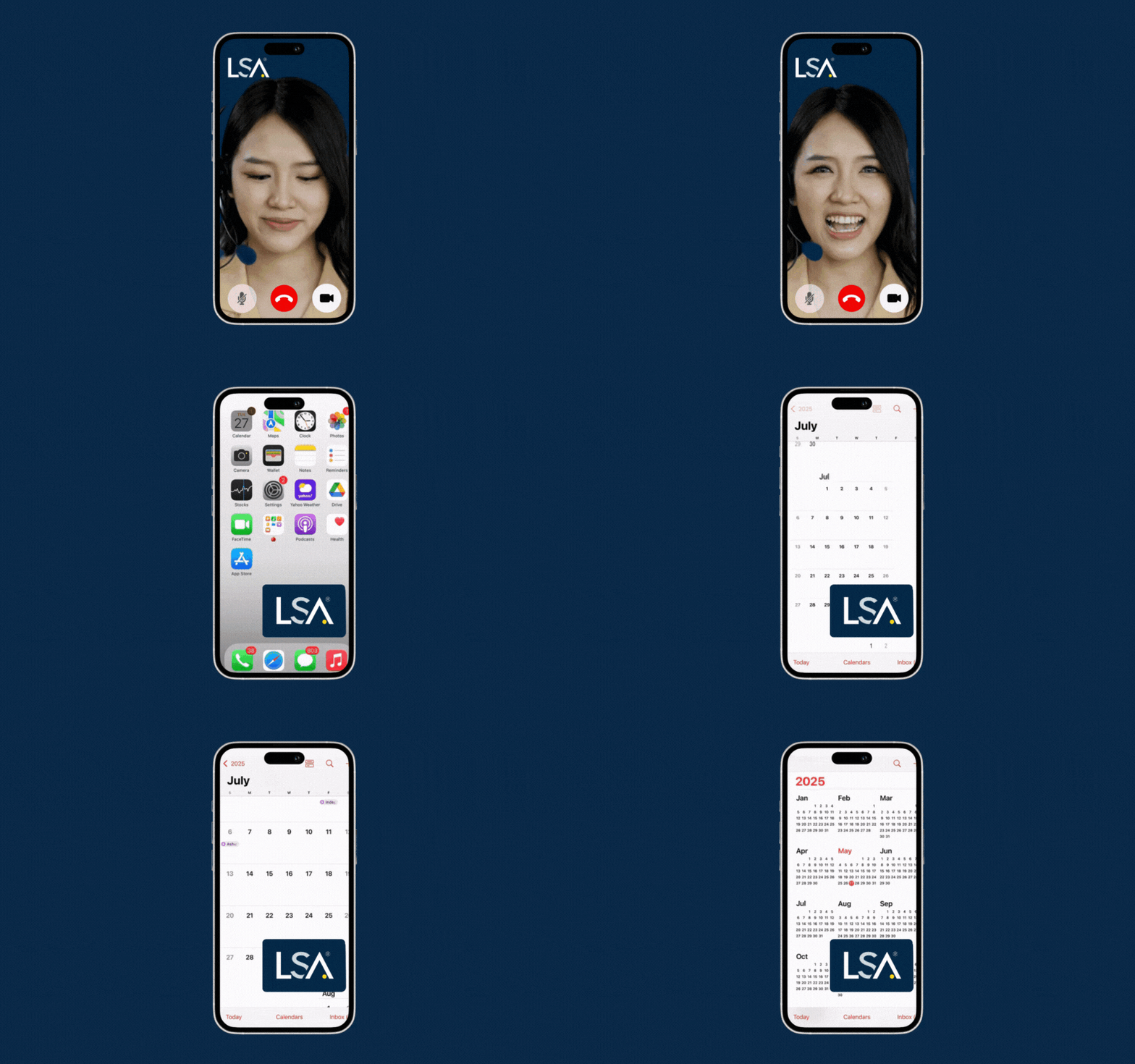
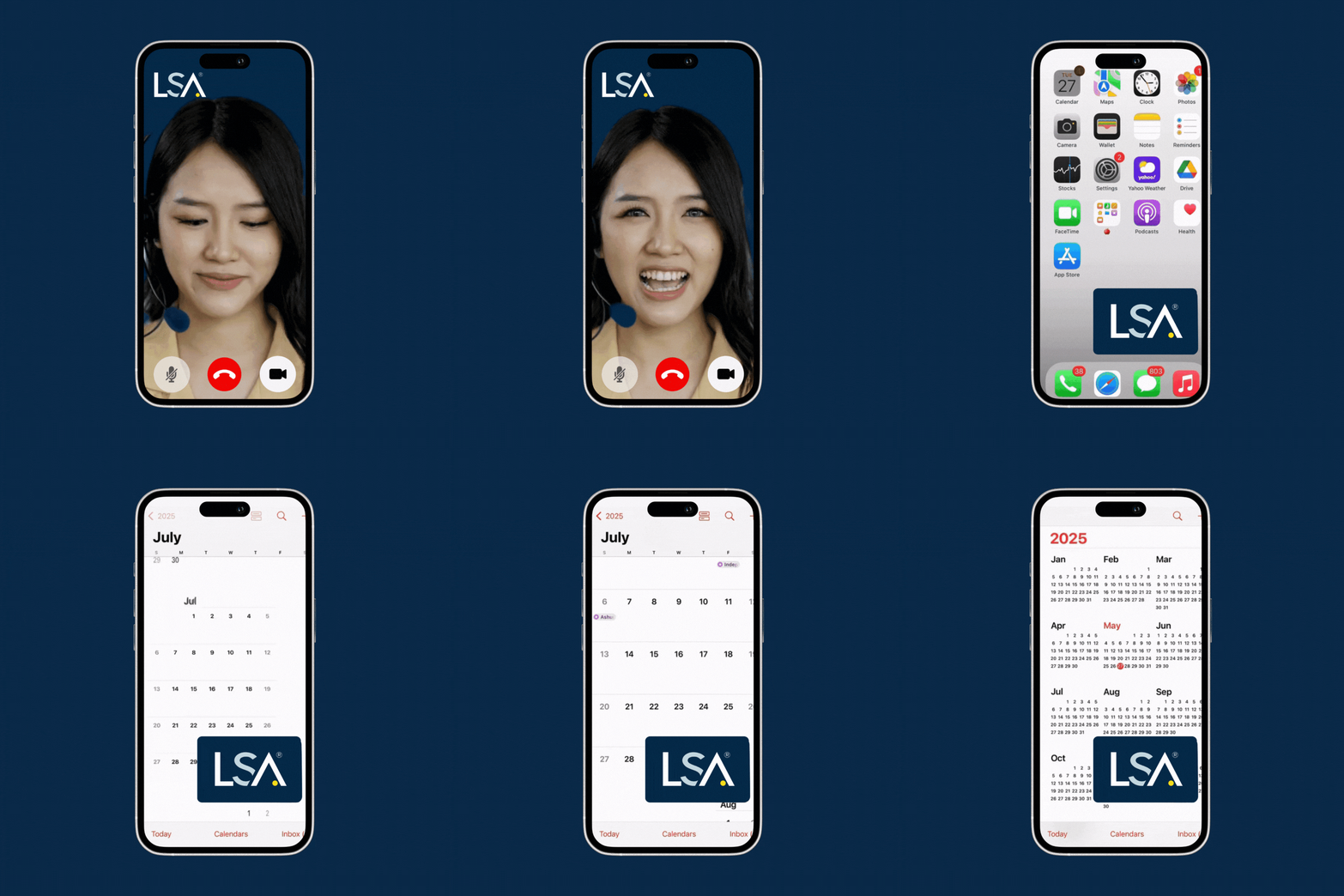
  • Customers can now schedule video interpretation services through the LSA Client Portal in addition to audio and onsite interpretation services. 
  • The LSA App now offers a picture-in-picture feature for video calls, so you can toggle multiple screens on your device without losing sight of your call.

Over the Phone Interpretation Add-Ons

LSA’s Reverse Call Flow

When a non-English-speaking patient or customer calls and can’t tell you which language they speak, your staff has to figure it out, wait on hold, and go through interpreter introductions before the call can even begin. The result is unnecessary time spent and frustration for both your caller and your staff.

LSA’s coordinators are highly trained to assess a caller’s language using proven techniques. But our Reverse Call Flow is a superior option. This service allows limited-English proficient (LEP) patients or customers to connect with an interpreter before they reach your staff. When the non-English speaker calls in, they can select their language, and the call is routed directly to the right interpreter. The interpreter then conferences in your staff member, ready to begin the conversation. 

Save time, reduce costs, and give callers a more welcoming experience with our Reverse Call add-on.

Scheduled Over the Phone Interpretation

While on-demand OPI can be a lifesaver, especially in an emergency, LSA also offers the option to schedule calls. For rarer languages or specific appointment times, scheduling a call with an interpreter can eliminate wait times and uncertainty about obtaining an interpreter for a language of lesser diffusion and provide a better patient or customer experience.

LSA’s Call Back Feature

Now, if an interpreter isn’t available when you call, you don’t have to wait on hold. Simply leave your information with a coordinator, and we’ll call you back as soon as we’ve connected with an interpreter. Less waiting. Less hassle. More support — when you need it.

Epic Toolbox Recognition and Audio Solutions

LSA earned its designation in the Epic Toolbox, underscoring our commitment to delivering reliable language access services for healthcare systems worldwide. We’ve also introduced audio-only interpretation for clients who prefer it alongside our video services. 

New Partnership with Tampa Bay Sun

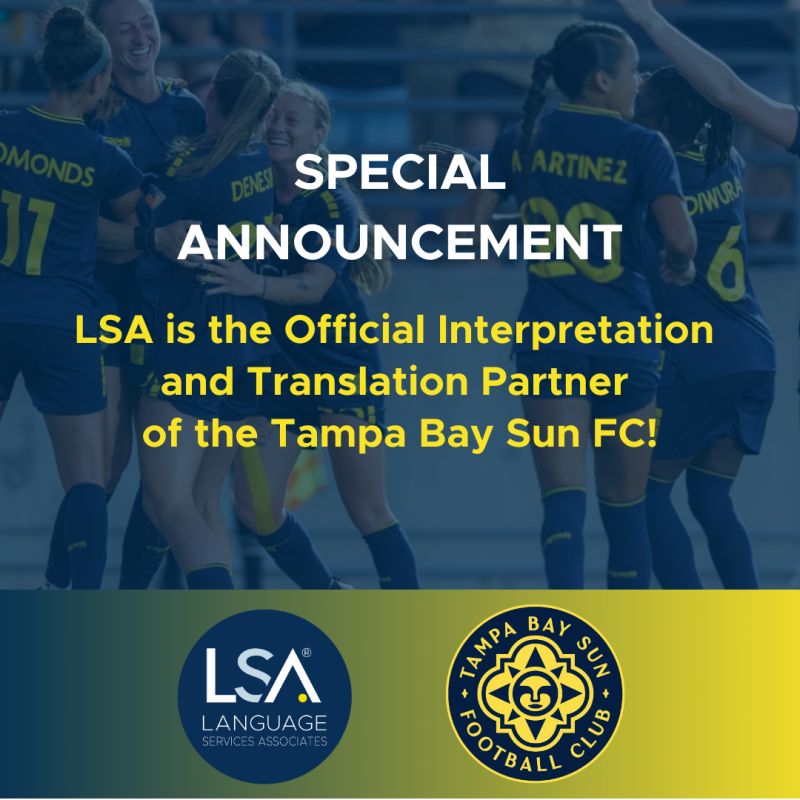
We have partnered with the Tampa Bay Sun as their official interpretation and translation provider! From ASL interpretation to translating important stadium signs and assisting with multilingual customer service, we’re helping their fans fully understand rules, payments, and more.

LSA is also the official interpretation and translation provider for the Philadelphia Union. Learn more about how we support sports, entertainment, and live venues with inclusive communication.

Top Workplaces Awards

Our team loves what they do — and that translates into better service for you. These awards prove it.

Three-Time Winner: Philadelphia Inquirer Top Workplace Award!

For the third year in a row, we’ve been recognized by the Philadelphia Inquirer as a Top Workplace! This award reflects our commitment to excellence, teamwork, and outstanding service.

LSA Awarded 2025 USA Today Top Workplaces Award

We were named a 2025 USA Today Top Workplace again. This marks the second time we’ve received this prestigious recognition, demonstrating our people-centered culture, team-focused environment, and employee-driven mindset.

Partner with a language services provider that values excellence, culture, and innovation.

Serving More Industries Than Ever

In 2025, we’ve expanded our services to meet the needs of more sectors, helping organizations of all kinds connect clearly and confidently with the people they serve.

We now offer services for:

Guest experience interpretation + translated guides/menus. Learn more.

Language support for sensitive conversations and comprehensive 360° care. Learn more.

Multilingual support to bridge language gaps for global audiences. Learn more.

Language access for policy clarity, claim accuracy, and stronger compliance. Learn more.

SEC-compliant interpretation and document translation. Learn more.

Access for students, families, and community programs. Learn more.

Don’t see your industry listed? Let’s talk—our solutions are as diverse as your clients.

Redefining Language Access for Lasting Impact

At LSA, we’re not just providing interpretation and translation — we’re redefining what language access looks like in 2025 and beyond. Whether through AI innovation, 24/7 interpreter access, or our commitment to cultural fluency, we help ensure every voice is heard.

Let’s reach more people, in more languages, together. Contact us today or visit www.lsa.inc.

Would You Let a Friend Perform Surgery or Represent You in Court? Then Why Would You Trust Them to Interpret?

9 min read

In This Blog Post

Why Untrained Bilingual Friends, Family, or Coworkers Should Never Replace Professional Interpreters

When you’re juggling tight budgets, limited staff, and urgent needs, turning to a bilingual friend, family member, or coworker to interpret can feel like a practical—and convenient—solution. After all, they’re available and usually eager to help. 

But good intentions aren’t enough. Using untrained, untested interpreters is a risky shortcut that can lead to serious misunderstandings, privacy breaches, lost revenue, and the potential for legal liability. 

professional interpretation

Interpreting isn’t just about speaking two languages. Without the right training, even well-meaning helpers can leave out important details, say the wrong thing, or cross lines they don’t realize are there. And it happens more often than you might think, especially in organizations that don’t have a clear plan for language access. 

With more than 67 million people in the U.S. speaking a language other than English at home, these challenges aren’t going away. Whether you’re supporting patients, customers, students, or coworkers, clear communication is too important to leave to chance. Professional interpreters know how to handle sensitive conversations in an accurate and respectful way, so that everyone walks away on the same page. 

So how do you protect your organization—and the people you serve—from the risks of “good enough” language help? This article will walk you through what’s at stake, where the dangers show up, and how Language Services Associates (LSA) can help you build a safer, more effective language access strategy. 

The Hidden Risks of Relying on Unqualified Language Support

One well-known healthcare case illustrates the danger clearly: A nine-year-old Vietnamese child was taken to a hospital for flu-like symptoms. Her parents spoke no English, and the staff relied on her 16-year-old brother to interpret. After miscommunication about medication instructions, the girl had a fatal reaction and died. The hospital later paid $200,000 in damages. 

This tragic event was preventable and happened only because the proper language support wasn’t used.

Outside of healthcare, similar risks apply. Misunderstood contracts, incorrectly completed government forms, or mismanaged customer service interactions can all result in lost business, legal exposure, and damaged reputations. 

What Professional Interpreters Are Trained to Do (And Why It Matters)

Professional interpreters are trained to go beyond simply relaying information. They understand context, tone, body language, and cultural nuance. They serve as impartial communicators, trained to deliver even the most sensitive messages with professionalism and accuracy.

In contrast, family members or untrained bilingual staff may inadvertently edit, soften, or omit critical information due to emotional involvement, discomfort, or lack of vocabulary. 

In a field like healthcare, this could mean failing to ask necessary medical questions that may be too intimate or embarrassing for a family member or friend to ask.

In legal or financial settings, it could result in misunderstood rights, risks, or obligations. In customer service, it could mean a lost client due to a poor experience.

Additionally, professional interpreters are fluent in the protocols and ethics required for sensitive interactions — whether that means understanding HIPAA protocols in a hospital, confidentiality in a courtroom, or customer privacy in finance. They’re also trained to remain neutral and objective — something that can be nearly impossible for someone personally connected to the situation. This professionalism also leads to better interactions, faster resolution times, smoother transactions, and even improved revenue for your organization.

When “Good Enough” Isn’t Good Enough: The Problem with Unvetted Bilingual Staff 

A bilingual coworker who claims to know enough to get by is not the same as a trained interpreter. While dual-role employees may help in basic interactions, you’ll need to assess their language ability and interpreting skills before allowing them to communicate in high-risk situations. LSA offers Language Assessments & Testing to confirm your bilingual staff meet industry standards. This secures compliance, reduces liability, and protects your brand and the people you serve. It will also strengthen customer confidence, reduce costly errors, and support retention. 

How LSA Can Help: Scalable Language Access Solutions for Every Industry

When there’s no clear system for language access, teams do what they can in the moment. That often means relying on bilingual coworkers or family members — not because it’s ideal, but because it seems faster, easier, or like the only option.

LSA helps you replace that uncertainty with a reliable, ready-to-go solution. We give your organization immediate access to thousands of rigorously vetted interpreters across nearly 300 languages. Whether you need Over the Phone, Video Remote, or Onsite support, our interpreters are trained in industry-specific terminology and ethical standards, delivering expert services when and where you need them. LSA’s customizable solutions are scalable and secure, meeting the demands of sectors like:

HIPAA-compliant interpretation across specialties

Accurate, confidential communication for sensitive matters

Multilingual assistance to drive loyalty and revenue

Seamless guest experiences for global clientele

Equitable access for students and families

What’s Next

LSA isn’t just a language service provider — we’re your partner in removing barriers, improving outcomes, and strengthening your connection to the people you serve. For our clients, compliance is just the baseline. They’re also discovering new pathways to revenue by creating inclusive, accessible, and reliable experiences for every audience. 

Let’s get your organization speaking all the right languages. 

Contact us today at (800) 305-9673 ext. 55305 or visit www.lsa.inc  to learn more. 

Language Services Associates Presenting at 2023 Delta Purchasing Alliance Member Summit

3 min readOn Thursday January 19th, 2023, Language Services Associates’ (LSA) Jerry Lotierzo, Strategic Sales Manager – GPOs, is heading to the yearly Delta Purchasing Alliance (DPA) Member Summit in Las Vegas, Nevada. Jerry will be representing LSA among a select 25 members that will be in attendance from some of the nation’s largest Federally Qualified health Centers where Interpreting services are required. Working alongside CEOs, CFOs, other DPA members, and health center finance, operations, and purchasing staff, Jerry will be presenting how LSA can partner with DPA members to provide solutions to make their community health centers more efficient through language access. As the only language provider presenting at the summit, we are honored to have Jerry share our story, history, philosophy, and our customizable solutions to meet every client’s needs.

Learn more about how LSA’s customizable solutions can make healthcare more equitable at your facility.

Contact:  Jerry Lotierzo at 800.305.9673 X55335 or [email protected]

About LSA

Language Services Associates (LSA) offers a full suite of language interpretation solutions to help optimize the experience of limited English proficient customers and patients. Providing native language support improves the efficiency and productivity of staff, raises customer satisfaction levels, and builds loyalty. For more than 2,000 clients worldwide, in more than 230 languages, LSA provides a competitive differentiator in the healthcare, government, financial and banking, insurance, entertainment, hospitality, and manufacturing industries.

Interpretation vs. Translation: Understanding the Key Differences

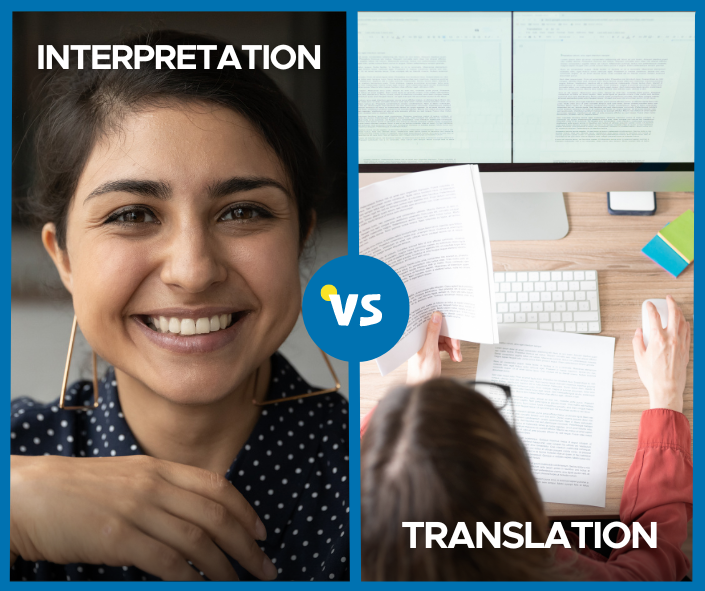
7 min readInterpretation and translation both promote breaking down language barriers, facilitating communication, and bringing cultures together. And while most people use the terms “interpreter” and “translator” interchangeably, the two disciplines require a different skill set and are rarely conducted by the same people. Outside of the language service industry, the terminology can be confusing. Understanding the intricacies of each unique medium will make it easier for organizations looking to partner with a language provider to acquire the solutions they need. 

The first major distinction between interpretation and translation is that interpretation is spoken, and translation is written. On the surface, this is the defining characteristic that sets each apart from the other. But let’s take a deeper dive into three key differences. 

1. Translation is Performed Over Time, Interpretation is Immediate

Interpretation is executed in real-time either over the phone, in person, or via video. During conversation, an interpreter needs to listen for, not only the words being spoken, but also the nuances, meanings, and tones being delivered. In many languages there are words that don’t always have an exact equivalent in another language. In these cases, an interpreter will have to think quick on their feet to render the meaning of what is being said and keep the conversation moving without losing accuracy. 

Since translation renders the meaning of the written word from one language to another, it doesn’t entail the same immediacy as live interpretation. Translation occurs subsequent to the development of the source and affords the translation team time to utilize terminology resources, parallel texts, specialized technology, and other support tools to ensure the text is translated exactly as the author intended. 

2. Fluency and Direction 

Interpreters need to be fluent in both languages they work with. During quick back-and-forth exchanges the ability to instantly understand what is being said and relay that information accurately is critical to the task at hand. They need to work well under pressure and have superb communication skills. 

While translators need native fluency in the source language as well as the target language, they only work into their native language. They must have remarkable comprehension skills and an almost innate ability to transfer from the source language to the target language. They have the option of consulting terminology resources, specialized subject-area reference material, and making use of the most current technology to support their work.  

3. Collaboration 

While both interpretation and translation require teamwork, the people they work with are quite different. Interpreters work directly with clients and their limited English proficient customers or patients in realtime. They depend on their memory and fluency in the two languages to quickly work with each speaker in the absence of any external tools or resources for support. 

In translation, a project can go through several stages and edits, and involve a team of translators, editors, proofreaders, and project managers all working together to assure that the intended meaning of the original material is kept intact. Translators rely on their expert reading comprehension skills, and their ability to accurately render written material into the target language. 

Interpretation and translation are closely related in that they bring cultures together and remove language barriers; however, the skill sets required are ultimately quite different. Understanding these key differences can make it easier to navigate the solutions offered by language service providers. 

Learn more about LSA’s interpretation and translation services today! 

Contact our team at 800.305.9673 X55305 or fill out our contact form in seconds.

About LSA 

Language Services Associates (LSA) offers a full suite of language interpretation solutions to help optimize the experience of limited English proficient customers and patients. Providing native language support improves the efficiency and productivity of staff, raises customer satisfaction levels, and builds loyalty. For more than 2,000 clients worldwide, in more than 230 languages, LSA provides a competitive differentiator in the healthcare, government, financial and banking, insurance, entertainment, hospitality, and manufacturing industries.

Vizient Awards LSA 3-Year Contract for Language Services

6 min read

FOR IMMEDIATE RELEASE: 

Media Contact:
Jerry Lotierzo
Strategic Sales Manager – GPOs 

[email protected] 

800.305.9673 X55335 

Vizient Re-Awards Language Services Associates, Inc. 3-Year Contract 

Horsham, PA August 2021   Language Services Associates (LSA) is pleased to announce that it has been re-awarded a three-year contract with Vizient.  LSA is a full-service provider of onsite and remote interpretation and translation solutions for more than 230 languages. With LSA’s scalable solutions and innovative technology, the contract makes LSA’s language service options available to all Vizient member hospitals at contracted pricing. 

Vizient is one of the largest member-driven, healthcare performance improvement companies in the country. Its suppliers help strengthen Vizient members’ delivery of high-value care through a commitment to quality and performance. LSA’s comprehensive suite of language services enables Vizient members to achieve their health equity goals by eliminating disparities and improving the health of all patient groups and populations while simultaneously controlling language services costs through the intelligent utilization of multiple language services modalities and technologies.  

For over thirty years, LSA has been a national leader in language services solutions for healthcare organizations, financial services, insurance, Medicare call centers, conferences, and any setting where communication is key. LSA offers a full suite of real-time, seamless interpretation solutions by phone, video, or in-person, scheduled or on-demand. LSA also provides document and website content translation services as well as language assessments.  

“Language Services Associates is delighted to continue our trusted partnership with Vizient,” said Scott F. Cooper, LSA’s President. “It is a fantastic achievement for LSA, but it is also a testament to Vizient and their members’ commitment to optimizing language access and equity for limited English-speaking and Deaf and Hard of Hearing communities through this relationship. The Vizient Membership has embraced the benefits of our best-in-class interpretation and translation services for over 10 years, and we look forward to continuing and expanding our membership relationships,”.  

LSA uses a distributed interpreter model, which means it is not as susceptible to business disruptions as large centrally located call centers. “We pride ourselves on top quality in both pillars of language services: best in class interpreters and the technology to swiftly deliver them,” said Mr. Cooper. “In the swiftly evolving technological landscape since COVID, LSA’s people and technology remain more agile than ever, allowing our customers to focus on what they do best.” 

“Additionally, our choice of flexible, seamless platform delivery models including integration into most Telehealth platforms available today provides a more efficient & effective overall patient experience,” said Jerry Lotierzo, LSA’s lead liaison to Vizient. 

LSA delivers industry-leading integration of interpretation services through a wide array of complex platforms including remote encounters, health system EHRs, and multi-party interactions. Sophisticated solutions offer healthcare organizations much-needed flexibility and choice given their rapidly changing delivery model and continued growth of telehealth accessibility. 

Quality interpretation in the healthcare space helps overcome language barriers of at-risk population groups and delivers important healthcare access to all. Providing interpreters reduces patient readmission rates, helps with patient outcomes, and contributes to greater clinician efficiency while meeting important compliance mandates. 

About LSA 

Language Services Associates is a full-service national leader delivering interpretation and translation solutions via telephone, video, and in person. Thousands of clients worldwide rely on LSA’s unique combination of state-of-the-art technology, a global roster of highly qualified interpreters providing more than 240 languages, and over 25 years of industry expertise.  It is based just outside of Philadelphia with a national footprint.  It is a 100% woman-owned business. www.LSAweb.com 

###