Nine Ways Organizations Can Strengthen Multilingual Engagement in 2026

17 min read

In This Blog Post

If your language access strategy hasn’t changed in the last few years, your team may struggle to keep up in 2026.

When language access is handled thoughtfully and consistently, organizations see tangible benefits across their operations. Partnering with a professional language services provider like LSA supports:

Improved satisfaction and trust

Unified messaging across languages

Reduced miscommunication-related risks

Stronger brand reputation

Shortened appointment and interaction times

Deeper engagement with multilingual audiences

Ethical, compliant communication practices

From patients and customers to sports fans and community members, professional interpretation and translation solutions provide an experience that strengthens connection, confidence, and belonging.

Because language access now touches so many core outcomes, it can no longer be treated as a standalone service. 

In 2026, effectiveness depends not just on interpreters or translations, but on how those services fit into daily workflows, technology systems, and compliance requirements. 

Drawing on LSA’s latest innovations and decades of experience, here are nine ways organizations can better engage with multilingual communities, and how LSA can help.

1. Improve Communication and Reduce Risk by Choosing the Right Interpreting Mode

Not every interaction needs the same interpreting setup. A routine customer service call may work well over the phone, while a legal proceeding or medical appointment often requires video or in-person interpreting to capture visual cues, tone, and context. Choosing the right interpreting mode helps organizations communicate more clearly and reduces risk in every situation.

LSA offers a full spectrum of interpreting services including Over the Phone (OPI)Video Remote Interpretation (VRI), scheduled phone or video sessions, AI Interpretationonsite interpreters for in-person meetings, and more. With coverage in 300 languages, including rare dialects and American Sign Language (ASL), this flexibility means you always have access to competent professionals when and where you need them most.  

By giving teams the ability to choose the correct modality for each interaction, organizations can better provide clear, accurate communication for any situation. 

2. Combine AI and Human Interpreters to Meet Demand Without Compromising Quality 

Demand for language access is growing faster than many organizations can staff for with human interpreters alone. At the same time, not every interaction carries the same level of risk or complexity, and AI cannot fully replace the judgment and cultural understanding human interpreters provide. Companies that fail to recognize this will find themselves at a disadvantage.  

That’s why the future of language access lies in the collaboration between humans and AI. By combining AI interpretation with human interpreters, organizations can meet high-volume, lower-risk needs quickly while reserving human expertise for conversations that require nuance, judgment, and cultural understanding — without compromising overall quality. 

At LSA, we have crafted our solutions to harness the strengths of both. Our AI interpretation technology delivers rapid, scalable, and convenient services, while our skilled interpreters provide high-quality cultural insight and ethical integrity. 

With our approach:

AI interpretation caters to urgent, low-risk requirements.

Human interpreters support complex or high-stakes conversations.

This hybrid model improves efficiency, standards of care, service, and trust across industries.  

3. Remove Friction by Building Language Access into Daily Workflows 

In fast-paced environments, staff don’t have time to search for language services or switch between systems. If requesting an interpreter takes too many steps, language access becomes an obstacle instead of support.  

By building interpretation and translation directly into the workflows teams already use, your organization can remove friction and make multilingual communication easier to deliver consistently. 

Some examples of this include:

Integrating interpreters within electronic health record (EHR) systems such as Epic

LSA integrates interpreters directly into EHR systems, like Epic, through secure API connections. LSA can also be found in the Epic Toolbox (not just the Epic Showroom), meeting Epic’s recommended standards for secure, reliable access to professional interpreters in hundreds of languages. This allows hospitals and health systems to request interpreters directly from their patient records system. 

Incorporating language preference options into customer or patient profiles

Automating notifications and reminders in multiple languages

Other workflow-enhancing tools, like LSA Reverse Call Flow, Smart Check, and our Call Back feature, customize how calls and interpretation requests are routed to minimize wait time and improve efficiency.  

When language access is built into daily workflows, staff are more inclined to use it, leading to a consistent and equitable experience for clients.

4. Extend Reach and Engagement by Making Video and Audio Content Multilingual 

Video now plays a central role in how organizations communicate with their audiences. Multilingual audiences expect access to it as well, but language barriers can limit their engagement.   

Solutions like LSA’s AI Video Dubbing make it easier to create accessible content on a large scale. 

Organizations can use multilingual video for: 

Patient or customer education

Training and onboarding

Public-facing communications

Social media and short-form content

For decades, subtitles and voiceovers have been the go-to methods for making video content accessible to multilingual audiences. Nevertheless, they have their drawbacks. Subtitles split the viewer’s focus between reading text and watching the video. Voiceovers can sound inauthentic and lack the speaker’s original emotional nuances. Conventional dubbing can be costly and labor-intensive, necessitating detailed manual synchronization.

LSA’s AI Video Translation & Dubbing uses cutting-edge AI technology to clone the speaker’s voice, sync lip movements, and deliver an authentic viewing experience in the target language.

5. Translate High-Volume Content Faster and More Cost-Effectively with LSA AI Machine Translation+ 

Many organizations produce large volumes of content that need to be translated quickly: websites, forms, educational materials, marketing content, etc. Translating these materials manually can be costly and time consuming.  

But for low-risk content that has little legal bearing or specialized terminology, LSA AI Machine Translation+ combines advanced AI translation with human editing for accuracy and consistency. 

It’s ideal for: 

Websites

Knowledge bases

User instructions

Educational materials

Internal documentation

Combining machine translation with human review offers a faster, more cost-effective way to translate high-volume content for multilingual audiences. 

6. Prepare for Changing Community Needs by Supporting Rare and Less Common Languages 

As communities evolve, language needs extend beyond the most commonly spoken languages. Popular languages are often served, but rare dialects and under-represented languages can sometimes be harder to accommodate. Supporting a broader range of languages helps organizations meet changing community needs and provide more equitable access for everyone they serve. 

LSA’s expanded coverage in over 300 languages, including rare dialects, makes it so that organizations can offer better service to all clients, patients, or customers, not just those speaking common languages.

This enables organizations to uphold equity and inclusion, ensuring no one is left behind due to language barriers. 

7. Safeguard Data and Maintain Compliance with Secure Language Services

Language services often involve sensitive personal, medical, or educational information. With the rapid rise of AI language tools, protecting that information has become a top priority. Without proper safeguards, interpretation and translation can introduce privacy and compliance risks. 

Organizations should evaluate: 

Whether their AI interpretation and translation tools are secure

How data is stored, anonymized, or deleted

Compliance with HIPAA, FERPA, and industry standards

Whether their language provider uses SOC 2–compliant systems

LSA supports industry standards through secure systems, SOC-2 compliance, and rigorous interpreter and translation protocols that align with regulations such as HIPAA, FERPA, and other data-privacy requirements.  

This keeps multilingual services secure, ethical, and compliant — whether delivered through interpreting, translation, or website localization. 

Strong governance builds trust and reduces risk. 

8. Increase Adoption and Effectiveness Through Language Access Training 

Successful multilingual engagement depends on high-quality interpreters and translation tools. But if you don’t have staff who understand when, how, and why to use them, then they don’t provide much of anything at all. 

Organizations see higher adoption and better outcomes when staff are trained  in the effective use of interpreters, language tools, when to use each modality, and clear communication practices.

LSA supports these efforts with consultation, training, and ongoing support, which are especially useful for sectors like healthcare, education, legal, and public service.

9. Use Data and Analytics to Optimize Language Access Programs 

In 2026, leading organizations will use data to refine their language access strategies. 
 
Language access works best when it’s guided by data rather than guesswork. Without visibility into demand, usage, and performance, organizations risk long wait times, unnecessary costs, or using the wrong modalities. Using data and analytics helps teams optimize language access programs by aligning resources with real needs and improving outcomes over time. 

LSA’s Client Portal provides visibility into interpretation and translation requests, usage patterns across languages and modalities, turnaround times, and important KPIs.

Metrics to evaluate include: 

Language demand trends

Interpreter utilization

Cost efficiency across modalities

Translation turnaround times

User satisfaction and outcomes

This allows organizations to make informed decisions like when to use Machine Translation+ vs. human translation, which languages need more support, and where language demand is rising so resources are allocated where they matter most. 

Is Your Language Access Program Ready for 2026?

Use this quick self-assessment to evaluate whether your current approach is keeping pace with changing expectations: 

Do we choose interpreting modes intentionally based on the situation, risk level, and communication needs?

Do we use AI and human interpreters together in a way that balances speed, scale, and quality?

Is language access integrated into the systems and workflows staff use every day?

Are our video and audio communications accessible to multilingual audiences, not just our written materials?

Do we have a scalable approach for translating high-volume, low-risk content efficiently?

Can we support rare and emerging languages as our communities continue to evolve?

Are our language services secure and compliant with relevant privacy and data protection requirements?

Do staff understand when and how to use language access tools and services effectively?

Are we using data and analytics to monitor demand, performance, and outcomes across languages and modalities?

Your Next Steps for Strengthening Language Access 

Strong multilingual engagement in 2026 means embracing a comprehensive language services strategy and building accessibility, compliance, and inclusion into your organization’s core operations. 

At LSA, we offer a full suite of scalable solutions designed to meet every language need with accuracy and consistency. We support organizations across the full lifecycle of language access — from interpreting and translation to technology, compliance, and program optimization. 

With over three decades of experience, we are committed to helping organizations navigate the complexities of language access thoughtfully and efficiently. If you’re ready to build or enhance a language access program that serves all communities and celebrates every voice, LSA is here to help.

Ready to strengthen your language access program? Connect with LSA to discuss practical next steps for your organization.

Prefer to start with a self-assessment? Download our Language Access Checklist to see where you stand.

Why Leading Insurance Providers Partner with LSA for Language Access Solutions

10 min read

In This Blog Post

Breaking Language Barriers for Clearer Communication and Greater Equity

Understanding insurance is complicated, even for native speakers. When policyholders and agents don’t share the same language, even simple claims or coverage explanations can turn into confusion, delays, or missed opportunities.  

This is why effective communication and tailored services are crucial in the insurance sector, and why regulations demand transparent fine print. And while the law requires the same clarity for limited English proficient (LEP) policyholders as for native speakers, the barriers to effective communication become even more pronounced for customers who do not understand the language. This leads to missed opportunities for both the customer and insurance provider. 

Here is where Language Services Associates (LSA) plays a vital role. For over three decades, LSA has partnered with leading insurance carriers, Third Party Administrators (TPAs), and agencies to deliver fast, secure, and professional interpretation and translation services. Assisting a new policyholder? Processing claims? Supporting a multilingual call center? LSA has a solution that fits. 

LSA’s insurance services come with interpreters and translators with expertise in your field. Read on to learn more about the importance of language access in insurance and how LSA does it best. 

The Role of Language Access in Insurance

More than 67 million people in the U.S. speak a language other than English at home. Without professional language services, critical information about coverage, eligibility, and benefits can be lost in translation. 

Beyond compliance with laws like Title VI and Section 1557, effective language support helps insurers reduce errors, improve member satisfaction, and create a culture of inclusion. 

Policy translations, live interpretation during customer calls, onsite support for sensitive claims, AI interpretation for routine communication, and more, language services strengthen trust, help meet compliance standards, and allow you to provide comprehensive coverage for your diverse communities.

Built for Compliance, Security, and Trust 

Insurance organizations handle sensitive personal data every day. That’s why LSA integrates strict security protocols, data encryption, and HIPAA- and CMS-compliant processes into every service. 

Our interpreters and translators are rigorously vetted and trained to uphold the highest confidentiality standards, ensuring that your clients’ information is always protected. Skills-based routing also guarantees that only interpreters with expertise in your insurance field are connected to your calls. 

How LSA Helps Insurers Communicate with Confidence 

LSA combines human expertise with advanced technology to deliver fast, accurate, and accessible communication at every step of the policyholder journey. 

Our services include:

Over the Phone Interpretation (OPI)

Immediate access to expert interpreters 24/7/365, to support your customer service, claims, and underwriting teams.

Video Remote Interpretation (VRI)

Confidential information is protected with advanced encryption both in transit and at rest. Our secure platforms are built for reliability, with 99.9% uptime that ensures interpretation and translation sessions remain both safe and accessible whether delivered by phone, video, onsite, in writing, or through AI-powered services.

Onsite Interpretation

In-person language support for claims, assessments, and hearings. LSA provides expert onsite interpreters who understand the nuances of insurance communication and terminology.

American Sign Language (ASL)

Supporting Deaf and Hard of Hearing clients with certified interpreters available 24/7/365 onsite or via video.

Translation & Localization

Professional translation for claims documents, marketing materials, and policyholder communications.

AI-Powered Language Solutions

Harnessing the power of AI for speed and scalability, including AI Interpretation, AI Video Translation & Dubbing, and Machine Translation+. Every AI-powered solution is backed by human oversight,or the ability to transition to a human interpreter, to maintain quality and context. 

7 Steps to Equitable Insurance Access and How LSA Brings Them to Life

Offer non-native English speakers full access to your insurance services. LSA helps you build fairness and clarity into every conversation. We’ll work with you to effectively engage your diverse communities, beginning with the following steps: 

1. Know Your Customers

Recognize where clients most often need interpretation or translation.

LSA helps insurers analyze demographics and plan accordingly.

2. Map Key Touchpoints

Recognize where clients most often need interpretation or translation. 

Our services cover every access point — call centers, claims, onboarding, and in-person meetings.

3. Develop a Language Access Plan

Create a formal plan to provide consistent support.

LSA offers consultation to design or enhance compliant language access programs.

4. Train Your Team

Staff should understand how and when to engage an interpreter.

LSA provides training during onboarding and materials, including Desktop Reference Cards, “One-Moment-Please” signs, and other user-friendly resources.

5. Make Communication Visible

Show clients you’re ready to support them in their preferred language. 

Our translation and localization services help you build multilingual portals, materials, and signage.

6. Gather Feedback

Monitor satisfaction and accessibility through client and interpreter feedback. 

LSA integrates reporting tools and performance tracking into your workflow.

7. Measure and Improve

For continuous improvement and a program aligned with your business goals, you need to regularly evaluate performance.  

We provide transparent reporting, QA audits, regular check-ins, and KPI tracking to help you evolve over time.

Arrow

For a more detailed guide, check out our blog post: 7 Steps to Equitable Insurance Access for Non-Native English Speakers. 

Why Leading Insurers Choose LSA

300 languages supported

7,000+ carefully vetted professional linguists 

Integrated technology and a proprietary client portal for easy scheduling and visibility

AI efficiency + human expertise for faster, scalable service

Over three decades of trusted experience serving the insurance, healthcare, and government sectors

Bridge the Language Gap and Build Stronger Client Relationships

At LSA, we help insurance providers communicate with confidence, compassion, and compliance, no matter what language your clients speak. 

Contact us today to learn how LSA can help you deliver better customer experiences with our interpretation and translation services

Language Services Associates Presenting at 2023 Delta Purchasing Alliance Member Summit

3 min readOn Thursday January 19th, 2023, Language Services Associates’ (LSA) Jerry Lotierzo, Strategic Sales Manager – GPOs, is heading to the yearly Delta Purchasing Alliance (DPA) Member Summit in Las Vegas, Nevada. Jerry will be representing LSA among a select 25 members that will be in attendance from some of the nation’s largest Federally Qualified health Centers where Interpreting services are required. Working alongside CEOs, CFOs, other DPA members, and health center finance, operations, and purchasing staff, Jerry will be presenting how LSA can partner with DPA members to provide solutions to make their community health centers more efficient through language access. As the only language provider presenting at the summit, we are honored to have Jerry share our story, history, philosophy, and our customizable solutions to meet every client’s needs.

Learn more about how LSA’s customizable solutions can make healthcare more equitable at your facility.

Contact:  Jerry Lotierzo at 800.305.9673 X55335 or [email protected]

About LSA

Language Services Associates (LSA) offers a full suite of language interpretation solutions to help optimize the experience of limited English proficient customers and patients. Providing native language support improves the efficiency and productivity of staff, raises customer satisfaction levels, and builds loyalty. For more than 2,000 clients worldwide, in more than 230 languages, LSA provides a competitive differentiator in the healthcare, government, financial and banking, insurance, entertainment, hospitality, and manufacturing industries.

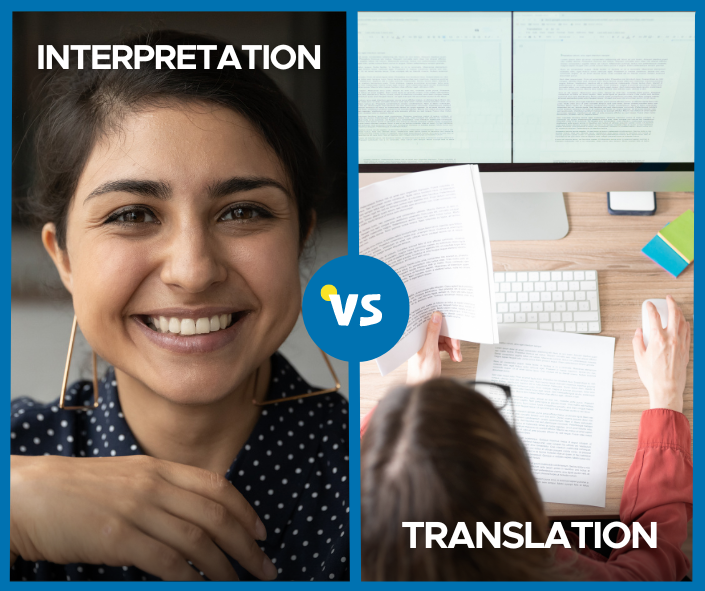
Interpretation vs. Translation: Understanding the Key Differences

7 min readInterpretation and translation both promote breaking down language barriers, facilitating communication, and bringing cultures together. And while most people use the terms “interpreter” and “translator” interchangeably, the two disciplines require a different skill set and are rarely conducted by the same people. Outside of the language service industry, the terminology can be confusing. Understanding the intricacies of each unique medium will make it easier for organizations looking to partner with a language provider to acquire the solutions they need. 

The first major distinction between interpretation and translation is that interpretation is spoken, and translation is written. On the surface, this is the defining characteristic that sets each apart from the other. But let’s take a deeper dive into three key differences. 

1. Translation is Performed Over Time, Interpretation is Immediate

Interpretation is executed in real-time either over the phone, in person, or via video. During conversation, an interpreter needs to listen for, not only the words being spoken, but also the nuances, meanings, and tones being delivered. In many languages there are words that don’t always have an exact equivalent in another language. In these cases, an interpreter will have to think quick on their feet to render the meaning of what is being said and keep the conversation moving without losing accuracy. 

Since translation renders the meaning of the written word from one language to another, it doesn’t entail the same immediacy as live interpretation. Translation occurs subsequent to the development of the source and affords the translation team time to utilize terminology resources, parallel texts, specialized technology, and other support tools to ensure the text is translated exactly as the author intended. 

2. Fluency and Direction 

Interpreters need to be fluent in both languages they work with. During quick back-and-forth exchanges the ability to instantly understand what is being said and relay that information accurately is critical to the task at hand. They need to work well under pressure and have superb communication skills. 

While translators need native fluency in the source language as well as the target language, they only work into their native language. They must have remarkable comprehension skills and an almost innate ability to transfer from the source language to the target language. They have the option of consulting terminology resources, specialized subject-area reference material, and making use of the most current technology to support their work.  

3. Collaboration 

While both interpretation and translation require teamwork, the people they work with are quite different. Interpreters work directly with clients and their limited English proficient customers or patients in realtime. They depend on their memory and fluency in the two languages to quickly work with each speaker in the absence of any external tools or resources for support. 

In translation, a project can go through several stages and edits, and involve a team of translators, editors, proofreaders, and project managers all working together to assure that the intended meaning of the original material is kept intact. Translators rely on their expert reading comprehension skills, and their ability to accurately render written material into the target language. 

Interpretation and translation are closely related in that they bring cultures together and remove language barriers; however, the skill sets required are ultimately quite different. Understanding these key differences can make it easier to navigate the solutions offered by language service providers. 

Learn more about LSA’s interpretation and translation services today! 

Contact our team at 800.305.9673 X55305 or fill out our contact form in seconds.

About LSA 

Language Services Associates (LSA) offers a full suite of language interpretation solutions to help optimize the experience of limited English proficient customers and patients. Providing native language support improves the efficiency and productivity of staff, raises customer satisfaction levels, and builds loyalty. For more than 2,000 clients worldwide, in more than 230 languages, LSA provides a competitive differentiator in the healthcare, government, financial and banking, insurance, entertainment, hospitality, and manufacturing industries.

Language Services Associates Named One of the World’s Most Active Translation & Localization Professionals on Social Media

4 min readIf a company is only as good as its employees, then Language Services Associates (LSA) is doing something right. DSMN8 – the premier Employee Influencer Platform – named LSA among its top ten in their “World’s Most Active Translation & Localization Professionals on Social -1k” list. 

Collecting data from thousands of companies, LSA’s employees rank among the highest when it comes to sharing LSA-related content across numerous social media platforms. Representing the language service provider’s talent, culture, inclusivity, and brand, LSA’s staff share in the “We Help People” philosophy that energizes the company and allows it to continue assisting organizations and their limited English proficient customers communicate. 

LSA’s employees regularly increase company awareness, boosting website traffic, and generating new business for the organization, helping it grow, and showcasing the pride taken in their everyday work and goals. As influencers, LSA’s employees display how much LSA effectively engages with its staff, and includes them in key decisions, while increasing its reach and allowing everyone to have a voice. 

For over 30 years LSA has been the leading language provider in the industry, offering flexible solutions for its clientele, keeping it at the forefront of translation and interpretation services. By utilizing the forward-thinking and creativity of its staff, LSA continues to thrive in a highly competitive ever-changing field. 

For more information and to see the complete “World’s Most Active Employees on Social” list, please click here. 


About LSA 

Language Services Associates (LSA) offers a full suite of language interpretation solutions to help optimize the experience of limited English proficient customers and patients. Providing native language support improves the efficiency and productivity of staff, raises customer satisfaction levels, and builds loyalty. For more than 2,000 clients worldwide, in more than 230 languages, LSA provides a competitive differentiator in the healthcare, government, financial, insurance, banking, entertainment, hospitality and manufacturing industries.

Language Services Associates Featured in CIO Applications, President Scott Cooper Talks Flexible Solutions and the LSA Difference 

4 min readLanguage Services Associates (LSA) was recently named one of the Top Ten Companies Providing Insurance Technology Solutions in 2022 by leading technology magazine, CIO Applications. CIO Applications features companies that distinguish themselves by providing unique solutions to their customers. LSA’s President, Scott Cooper, sat down with CIO Applications to elaborate on why LSA is not only a leader in insurance, but in every sector language touches.

Mr. Cooper makes note of LSA’s three-pillar approach – finding the best interpreters, leveraging technology to connect clients on their individual platform of choice in seconds, and providing the best customer service experience in the market.

Flexibility and technology tailored to each customer’s requirements are among the top reasons LSA excels when it comes to connecting clients with interpreters in record time. Mr. Cooper talks about the hurdles clients were confronted with when COVID changed the landscape of customer service in industries like healthcare, where compliance with HIPAA laws and other privacy regulations are a top priority. Giving customers the option to transition from their traditional in-person interpretation standard to telephone and video remote interpretation seamlessly, while not compromising value and privacy, was how LSA stayed ahead of the curve.

By implementing services that allow companies to integrate LSA’s technology into their own, LSA gives clients the solutions to continue doing business as usual. With minimal training, clients can use LSA’s services on any platform they are comfortable with, and virtually on any device.

In a specialized sector like insurance, it’s easy to get lost in translation. Even for English speakers some of the jargon can be confusing, leaving customers with more questions than answers. LSA provides highly qualified interpreters who specialize in Insurance, with an understanding of the vocabulary used, industry-specific terms, and the ability to explain difficult concepts to customers in their own language.

For the full article and interview, and to learn more about LSA’s communication expertise, please click here.

About LSA 

Language Services Associates (LSA) offers a full suite of language interpretation solutions to help optimize the experience of limited English proficient customers and patients. Providing native language support improves the efficiency and productivity of staff, raises customer satisfaction levels, and builds loyalty. For more than 2,000 clients worldwide, in more than 230 languages, LSA provides a competitive differentiator in the healthcare, government, insurance, finance, banking, entertainment, hospitality and manufacturing industries.

Vizient Awards LSA 3-Year Contract for Language Services

6 min read

FOR IMMEDIATE RELEASE: 

Media Contact:
Jerry Lotierzo
Strategic Sales Manager – GPOs 

[email protected] 

800.305.9673 X55335 

Vizient Re-Awards Language Services Associates, Inc. 3-Year Contract 

Horsham, PA August 2021   Language Services Associates (LSA) is pleased to announce that it has been re-awarded a three-year contract with Vizient.  LSA is a full-service provider of onsite and remote interpretation and translation solutions for more than 230 languages. With LSA’s scalable solutions and innovative technology, the contract makes LSA’s language service options available to all Vizient member hospitals at contracted pricing. 

Vizient is one of the largest member-driven, healthcare performance improvement companies in the country. Its suppliers help strengthen Vizient members’ delivery of high-value care through a commitment to quality and performance. LSA’s comprehensive suite of language services enables Vizient members to achieve their health equity goals by eliminating disparities and improving the health of all patient groups and populations while simultaneously controlling language services costs through the intelligent utilization of multiple language services modalities and technologies.  

For over thirty years, LSA has been a national leader in language services solutions for healthcare organizations, financial services, insurance, Medicare call centers, conferences, and any setting where communication is key. LSA offers a full suite of real-time, seamless interpretation solutions by phone, video, or in-person, scheduled or on-demand. LSA also provides document and website content translation services as well as language assessments.  

“Language Services Associates is delighted to continue our trusted partnership with Vizient,” said Scott F. Cooper, LSA’s President. “It is a fantastic achievement for LSA, but it is also a testament to Vizient and their members’ commitment to optimizing language access and equity for limited English-speaking and Deaf and Hard of Hearing communities through this relationship. The Vizient Membership has embraced the benefits of our best-in-class interpretation and translation services for over 10 years, and we look forward to continuing and expanding our membership relationships,”.  

LSA uses a distributed interpreter model, which means it is not as susceptible to business disruptions as large centrally located call centers. “We pride ourselves on top quality in both pillars of language services: best in class interpreters and the technology to swiftly deliver them,” said Mr. Cooper. “In the swiftly evolving technological landscape since COVID, LSA’s people and technology remain more agile than ever, allowing our customers to focus on what they do best.” 

“Additionally, our choice of flexible, seamless platform delivery models including integration into most Telehealth platforms available today provides a more efficient & effective overall patient experience,” said Jerry Lotierzo, LSA’s lead liaison to Vizient. 

LSA delivers industry-leading integration of interpretation services through a wide array of complex platforms including remote encounters, health system EHRs, and multi-party interactions. Sophisticated solutions offer healthcare organizations much-needed flexibility and choice given their rapidly changing delivery model and continued growth of telehealth accessibility. 

Quality interpretation in the healthcare space helps overcome language barriers of at-risk population groups and delivers important healthcare access to all. Providing interpreters reduces patient readmission rates, helps with patient outcomes, and contributes to greater clinician efficiency while meeting important compliance mandates. 

About LSA 

Language Services Associates is a full-service national leader delivering interpretation and translation solutions via telephone, video, and in person. Thousands of clients worldwide rely on LSA’s unique combination of state-of-the-art technology, a global roster of highly qualified interpreters providing more than 240 languages, and over 25 years of industry expertise.  It is based just outside of Philadelphia with a national footprint.  It is a 100% woman-owned business. www.LSAweb.com 

###