
Written by: Scott Cooper, CEO of Language Services Associates (LSA)
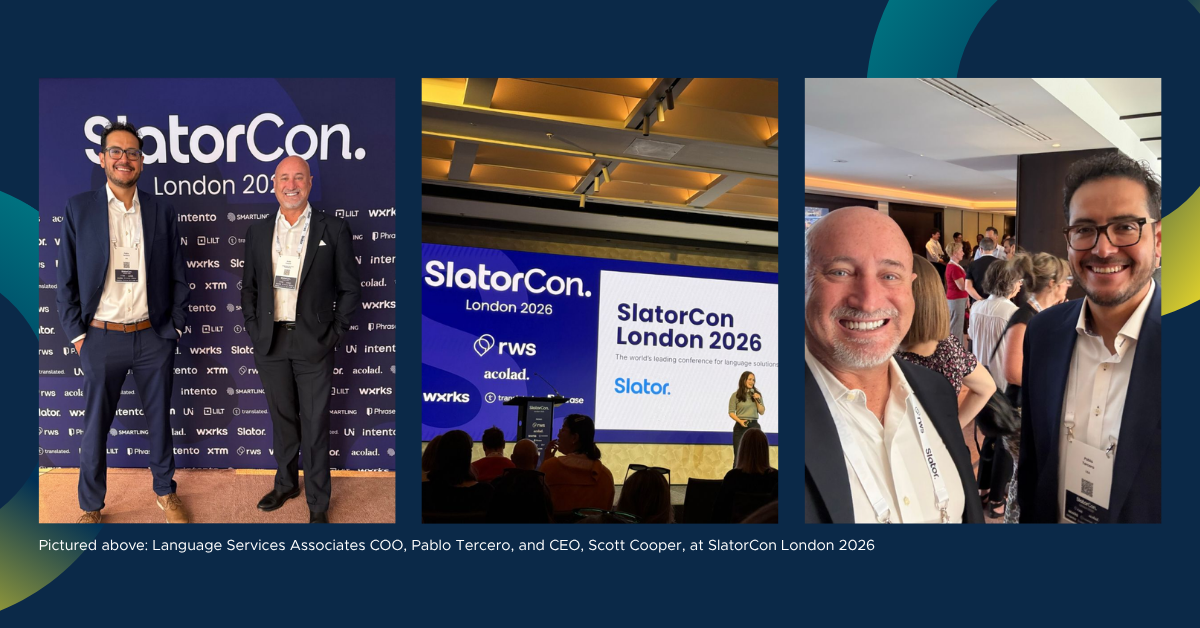
This past month, I had the privilege of attending SlatorCon London alongside our Chief Operating Officer, Pablo Tercero. This conference is widely recognized as one of the world’s premier thought leadership summits in the language solutions and AI spaces. It attracted industry leaders from across the globe and offered a timely pulse check on where our markets are heading.
Much has come into clearer focus since this event last year. There is near-universal recognition that change is occurring faster than ever, and that AI and human language solutions will evolve into a complex and symbiotic relationship moving forward.
Interest in AI remains very high, but so too is the recognition that core services and skills in our industry will endure for the foreseeable future. It will be all about balance and nuanced integrations. Many expressed customer concerns about not being able to integrate quickly enough to keep pace with new technology and related cost structures. To the positive, our conversations with fellow industry leaders confirmed that LSA remains at the forefront of innovation, blended solutions, and being a leader in assisting our clients navigate these changes.
I am delighted to share some of what we think the next few months will show.
Speed Is Overtaking Strategic Planning
Predicting strategy for our customers is only going to get harder. Industry leaders expressed universal concern that the change – while omnipresent in our industry – is happening almost too quickly for customers to make the informed decisions they need. Each day, there is a new promise of a “magic and cost-saving fix” that – even if true – is already obsolete by the time the next budget cycle is complete. C-Suite attendees talked openly about customers planning in monthly, not annual, models. This combines to make service planning for end users very difficult.
AI Is Accelerating — But Humans Remain Essential
There is no question that AI is transforming our industry. What this year’s conference confirmed, however, is that the recently predicted all-or-nothing solution set around AI has not, and likely will not, take hold for some time, if ever. Balanced solution sets, offering a mix of technology and human language skills, will remain the optimal solution. Per Slator, approximately 74% of language providers now have operationalized AI in their backend workflows, representing a dramatic increase from around 6% only three years ago. The same sources see no credible evidence to suggest full interpreter replacement.
Segmentation Will Be the Coin of the Realm
A clear segmentation is underway with technology handling more routine, repetitive, and non-life-threatening language encounters. But when language interactions become more critical, regulated, or complex, human escalation remains the delivery method of choice. Leading language companies are now more focused than ever on offering both elite interpreters and the call flow and onsite integrations that allow AI and other technology to escalate as needed. For those customers in the call center space, the ability to move conversations across languages, technology and humans will be the difference between success and failure. The narrative in 2026 has clearly matured, moving beyond experimentation and into practical integration. AI will increasingly enhance human expertise rather than replace it. There also remain significant gaps across certain language pairings.
Differentiation in our industry is no longer about whether a language provider uses AI, it’s about how effectively it integrates it. At SlatorCon, leading organizations, like LSA, emphasized three pillars of competitive advantage:
- Embedding AI directly into workflows
- Driving measurable efficiency and cost savings
- Maintaining trust, compliance, and quality assurance
This is where the bar is being set, and where customers are placing their expectations.
Rising Customer Expectations and the “AI Mandate”
Rising customer expectations, coupled with an increasing “AI mandate,” are reshaping how enterprise buyers evaluate solutions. Organizations are becoming more sophisticated and demanding in their procurement decisions, with AI capabilities now expected as a standard requirement rather than a differentiator. LSA saw this trend coming several years ago, leading us to partner with a dedicated AI interpretation company, Lingolet, to offer our customers these solutions. While many customers are moving forward with AI mandates, the most sophisticated buyers are still ensuring the AI supports traditional interpretation and translation offerings for all but the most basic of conversations and documents.
As noted, the most important structural shift discussed at SlatorCon was the rise of a hybrid delivery model:
- AI-led solutions for low-risk, high-volume, transactional interactions
- Human expertise for complex, sensitive, or escalated scenarios
This hybrid approach reflects both economic realities and customer expectations. It balances efficiency with quality and, importantly, preserves trust.
What This Means for Language Services Associates
Against this backdrop, I’m confident in LSA’s position.
In our 35th year, LSA has seen changes before in the language space and it will see more in the future. The only thing that does not change is that there will be change. Following our recognition by Nimdzi as the 36th-ranked global Language Service Provider, we are excited about the future.
Our strategic position is strongly aligned with the current pace of change in the industry, enabling us to adapt quickly and remain competitive as new technologies and business models emerge. Our innovative hybrid approach — combining artificial intelligence with human expertise — directly reflects the direction in which the market is evolving, allowing us to leverage the strengths of both automation and human judgment. At the same time, we continue to place a high priority on quality, compliance, and customer trust. These are critical areas where human insight, experience, and accountability remain indispensable, ensuring that our solutions not only drive efficiency but also uphold the highest standards our customers expect.
One thing, however, will never change: Language is about communication. LSA will never leave its core principle of listening to customers and offering solutions that meet their unique needs. Each change in technology is an opportunity to improve or confirm what is working for the customer.
I hope you found this update interesting. Let me know your thoughts.
A Leadership Imperative: Avoid Complacency
The most important message I want to leave with our team and stakeholders is simple:
We cannot afford complacency.
The industry is not standing still. Expectations are rising. Competitors are evolving. Customers are demanding more.
At LSA, our strength has always been our ability to combine innovation with execution. That remains our north star. We will continue:
- Advancing our AI capabilities
- Strengthening our hybrid delivery model
- Investing in systems and processes that create measurable value for our clients
Looking Ahead
SlatorCon reinforced both the challenges and the opportunities in front of us.
Yes, the market is under pressure.
Yes, the pace of change is accelerating.
But for organizations that stay focused, move decisively, and execute well, there is tremendous opportunity to lead.
At LSA, we are not just responding to change, we are positioning ourselves to shape it.
And we are just getting started.
— Scott Cooper
Chief Executive Officer, LSA
