
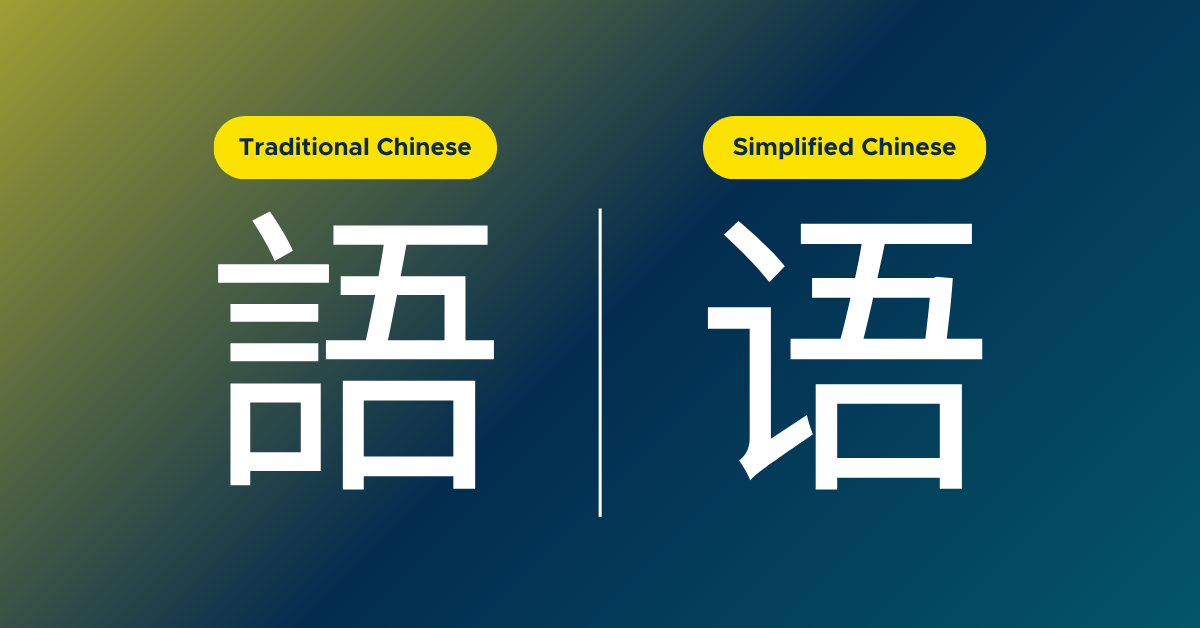
Traditional Chinese vs. Simplified Chinese: Choosing the Right Writing System for Translation

5 min read

Written by Molly MacPherson (Translation & Localization Manager at LSA) & Shenshen Jin (Translation Assistant Manager at LSA)

Overview

Table of Contents

Why Language Access Requires More Than Knowing the Spoken Dialect

You have a document for a Mandarin speaker, so you need it translated into Mandarin, right? Well, not quite…

Mandarin (and Cantonese and others) are spoken dialects of Chinese. The writing system, however, is not determined based on the dialect but rather based on geography and political history.

Understanding the History Behind Chinese Writing Systems

As part of the unification of China beginning in the 3rd century BCE, one goal was to standardize the writing system so that, even if the spoken languages were not mutually intelligible, the writing system was the same. This is the reason that Chinese writing is not primarily phonetic: the characters do not generally represent sounds, or phonemes. The writing system that emerged formed the basis of modern Traditional Chinese.

In the 1950s, the government of China undertook an initiative to improve literacy in the country. With thousands of complicated characters, more than 70% of the population remained illiterate. Initially, they reworked more than 500 commonly used characters and components, simplifying them to make it easier to learn to read and write. Since then, the number of simplified characters has expanded to over 2,000 in modern Simplified Chinese. The rest of the characters, many thousands of them, have remained unchanged; thus, Traditional and Simplified Chinese have many overlapping characters, but the ones used most frequently differ between them.

Where Are Traditional Chinese and Simplified Chinese Used?

Simplified Chinese began in China, but given its significant influence in the region, it has also been adopted by other communities overseas, such as Singapore, Malaysia, and Indonesia. Taiwan, Hong Kong, and Macau, however, have resisted this change and continue to use Traditional Chinese.

Chinese Translation Guide: Dialects and Writing Systems by Region

For a quick reference, here is a breakdown of primary dialects and writing systems in different regions:

Geographic LocationSpoken Dialect of ChineseChinese Writing System
Mainland ChinaMandarin (official)Simplified Chinese
Guangdong Province, PRCCantoneseSimplified Chinese
Hong KongCantoneseTraditional Chinese
MacauCantonese, MacaneseTraditional Chinese
TaiwanMandarin (de facto)Traditional Chinese
Singapore/Malaysia/IndonesiaMandarinSimplified Chinese
North AmericaIt depends!It depends!

Writing System Selection Tip: Geography, not Dialect

The bottom line is that knowing the dialect of Chinese a person speaks is not enough for knowing the writing system into which they will need their documents translated. The key is knowing their geographic origin!

Additional Resources on Traditional and Simplified Chinese

Professional Chinese Translation Services for Language Access

LSA helps organizations identify the right language solution for their audience and deliver accurate, high-quality translations that support meaningful communication.

From healthcare and government to education and business, our translation experts help organizations improve language access and connect with multilingual communities with confidence.

10 Ways Language Access Helps Schools Do More Than Meet Compliance

12 min read

Overview

Language access in education helps schools do far more than meet Title VI requirements. School interpretation services, professional translation, ASL, and AI-powered language solutions strengthen family engagement, improve student outcomes, support teachers, enhance emergency communication, and build trust across diverse school communities.

Discover 10 ways a comprehensive language access program can help your district communicate more effectively while supporting every student and family.

Table of Contents

Schools Are Expected to Do More Than Ever. Language Access Can Help.

About 1 in 5 school-age children in the U.S. speaks a language other than English at home. Every report card, enrollment form, and emergency alert your district sends has to reach their families in a language they understand.

Federal civil rights law agrees: Title VI compliance makes language access in education a legal obligation. But that’s not the only reason to make language access a priority. The districts seeing the best results treat school interpretation services and education translation services as investments in student achievement, family engagement, and community trust rather than a box to check.

When families fully understand what’s happening in their children’s classes, students benefit. Parents get more involved, teachers spend less time clearing up miscommunication, and the whole community is stronger for it.

With over 35 years of experience providing interpretation and translation services in the education field, we at Language Services Associates (LSA) have seen the difference clear communication makes for schools and districts firsthand.

Here are 10 ways language access does more for schools than keep them compliant.

1. Build Stronger Relationships Through Multilingual Family Engagement

Multilingual family engagement starts with a message parents can understand, in the language they know best.

When parents and guardians receive school information in their preferred language, they are more likely to attend conferences, participate in school activities, ask questions, and become active partners in their child’s education.

Professional language services for schools, including interpretation, translation, and AI language solutions, remove language barriers before a small misunderstanding turns into a missed conference or an unsigned permission slip.

2. Improve Student Outcomes Through Better Communication

More than 5 million U.S. public school students are English learners, about 1 in 10 nationwide.

Research consistently demonstrates a strong connection between family engagement and student success. In one Harvard study, when teachers sent families a short daily message, struggling students were more likely to complete the class. That only works if the family can read the message.

Parents who understand the report card, the attendance policy, and the available support services can reinforce learning at home and push for what their child needs.

Language access in education gives every student the same shot, no matter which language their family speaks at home.

3. Make Parent-Teacher Conferences More Meaningful

A parent-teacher conference should never feel like a guessing game.

Professional parent-teacher conference interpreters help educators and families talk through academic progress, classroom performance, behavioral concerns, learning goals, attendance, and support plans without guesswork on either side.

With an interpreter in the room (or on the screen), everyone leaves the meeting with the same understanding and the same next steps.

4. Support Special Education Services and IEP Meetings

Special education discussions often involve highly technical educational, medical, and legal terminology.

Qualified interpreters help families keep up with every step, from evaluations and eligibility determinations to therapy services, accommodations and modifications, and their own educational rights and responsibilities.

Helping families follow all of it is also a federal requirement. Special education rules direct schools to take whatever action is necessary to ensure parents understand IEP proceedings, including arranging an interpreter.

5. Prepare for Emergencies Before They Happen

In an emergency, a district has minutes, not days, to reach every family.

Professional education translation services get emergency messages out fast, in languages families can act on.

6. Reach Families Across Every Communication Channel

Schools now communicate with families through many different channels, not just printed notices.

Families expect information through school websites, parent portals, mobile apps, email, text messages, social media, phone calls, and virtual meetings. If a district translates its newsletters but not its texts, emails, or portal updates, families still miss important information.

7. Support Teachers, Administrators, and School Staff

Language barriers affect educators as much as families.

Teachers, counselors, nurses, administrators, front office personnel, and support staff frequently need to communicate with parents throughout the school day.

Federal guidance is specific on this point: schools may not ask students, siblings, or untrained bilingual staff to interpret for parents, and being bilingual by itself doesn't make someone a qualified interpreter. On-demand K-12 interpretation by phone or video puts a live interpreter on the line the moment staff need one.

8. Use AI-Powered Interpretation Solutions Responsibly

Routine conversations can’t always wait for a scheduled interpreter, and that’s exactly the problem AI interpretation solves.

That includes front office questions, enrollment and registration support, attendance calls, transportation questions, and everyday parent outreach.

Families get an answer right away, even at hours and in languages the district couldn’t otherwise cover.

However, conversations involving:

often require the cultural understanding, nuance, and accuracy that professional human interpreters provide.

The strongest programs use both: AI for routine, human interpreters for high-stakes conversations where accuracy and trust matter most.

LSA offers AI-powered interpretation solutions alongside professional onsite, video remote, and over the phone interpretation services.

The hybrid approach lets K-12 schools and districts expand language access and control costs while every family gets the right level of support for every conversation.

9. Strengthen Community Trust and Inclusion

In many communities, the school is the one institution nearly every family interacts with.

When those interactions leave families feeling informed and respected, trust grows. Language access demonstrates a district’s commitment to serving all families — not just those who speak English.

10. Choose a Language Access Partner That Grows with Your District

Every district’s language access needs are different.

Some schools need occasional parent-teacher conference interpreters. Others require:

The right language partner should be able to scale as enrollment, demographics, and communication needs evolve.

Language Access in Education Is About More Than Compliance

Title VI compliance sets the floor.

The best districts build well above it.

For more than 35 years, LSA has helped schools, universities, government agencies, healthcare organizations, and public-sector institutions do exactly that. That work includes interpretation, translation, ASL services, localization, and AI-powered language technologies in more than 300 languages.

At LSA, we believe that when families understand, students thrive.

Ready to Strengthen Communication Across Your District?

Contact LSA to talk through what a scalable language access program could look like for your schools.